
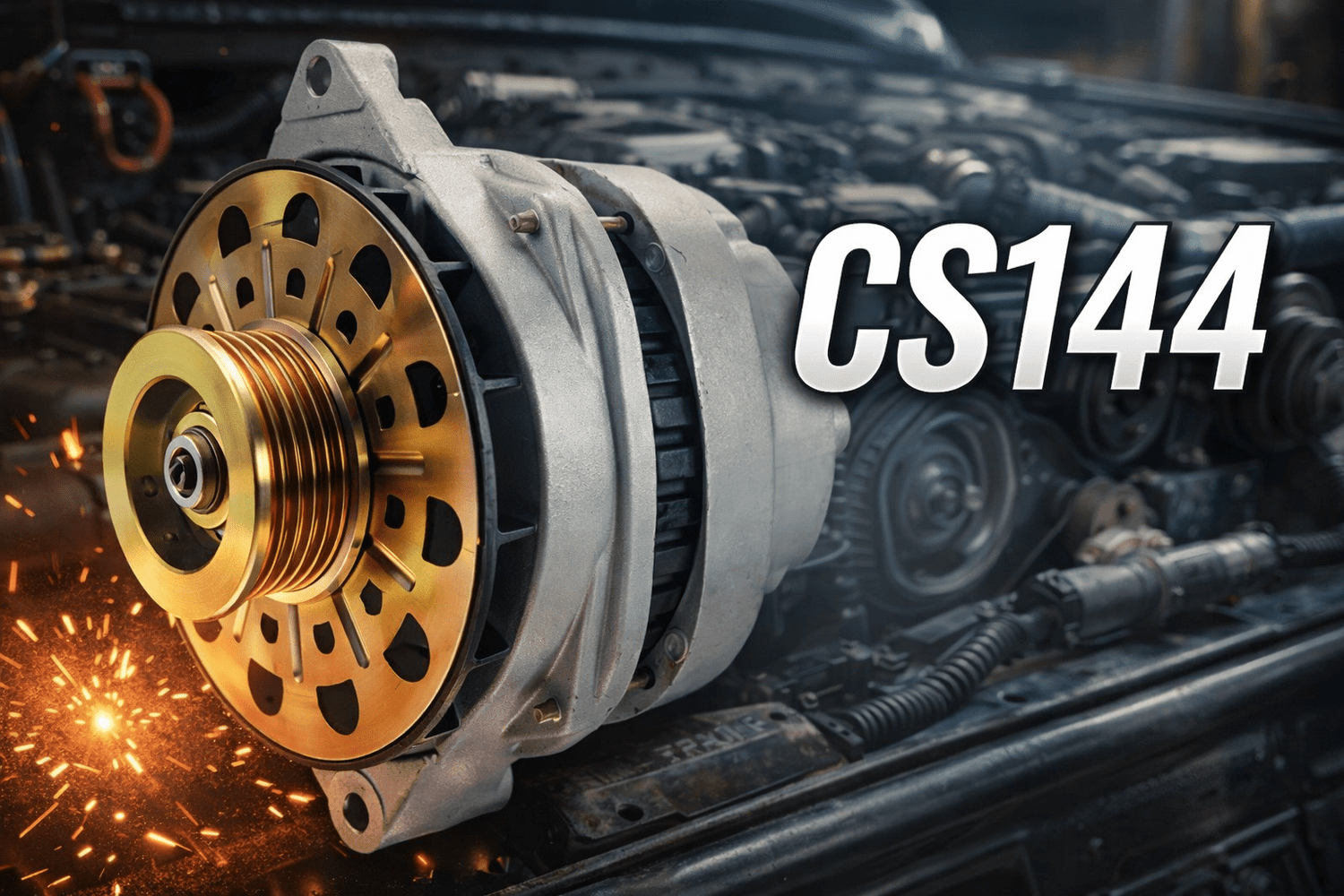
If you’ve added a winch, lights, a fridge, onboard air, dual batteries — or all of the above — you’ve probably noticed the factory alternator working harder than it was ever designed to. Most of these trucks came from a time when electrical demand was minimal. Modern builds are a different story.
The CS144 alternator swap is one of the most effective charging upgrades you can make. It delivers serious output, excellent performance at idle, and the reliability needed for vehicles that actually get used on the trail.
This guide covers:
- Which alternator to use
- What vehicles it fits
- A simple install overview
- How to keep the swap clean and reliable
Why Upgrade to a CS144?
Most older Toyota platforms came with 70–100 amp alternators. Once you start adding modern accessories, that capacity gets used up quickly.
Common electrical loads today include:
- Winch
- LED light bars and auxiliary lighting
- Dual battery systems
- Fridge/freezer
- Air compressor
- Overland power setups
The CS144 provides:
- 140–200+ amp output
- Strong charging performance at idle
- Excellent durability (originally designed for heavy-duty GM trucks)
- Easy availability at most parts stores
For trucks that spend time idling on the trail or powering accessories, the difference is immediately noticeable.

Compatible Toyota Platforms
This swap is commonly performed on the following vehicles:
4Runner
1996–2002 (3rd Gen)
Tacoma
1995–2004 (1st Gen)
Land Cruiser
1993–1997 FZJ80
Lexus
1996–1997 LX450
These vehicles use the factory Toyota oval 3-pin alternator connector (IG–S–L), making them ideal candidates for a clean CS144 conversion.
Which CS144 Alternator to Use
The most commonly used donor applications come from mid-90s GM heavy-duty vehicles.
Ask for a CS144 from:
1994–1996 Chevy / GMC
- C/K 2500 or 3500
- 5.7L (350) or 7.4L (454)
Also commonly used:
- 1994–1996 Suburban or Tahoe (5.7L / 7.4L)
- 1996–1999 Express / Savana vans
Many builders simply request:
1995 Chevy K2500 7.4L alternator
Look for:
- CS144 case style
- 140 amps or higher
- 6-groove pulley (swap pulleys if needed)
Keeping the Swap Plug-and-Play
Toyota uses a 3-pin IG–S–L connector, while the CS144 uses a GM-style regulator plug. A vehicle-specific adapter harness allows you to connect the new alternator without modifying the factory wiring.

This keeps the install:
- Clean and factory-looking
- Fully reversible
- Easy to service later
- Reliable in high-vibration, off-road environments
Plug-and-play harnesses are available for each platform:
4Runner (1996–2002)
https://teqoffroad.com/products/cs144-4runner-harness
Tacoma (1995–2004)
https://teqoffroad.com/products/cs144-tacoma-harness
Land Cruiser / LX450 (1993–1997)
https://teqoffroad.com/products/cs144-land-cruiser-harness
Each harness is built in-house by TEQ Offroad and finished in classic Toyota retro colors — a small nod to the heritage, even when you’re running GM charging power.
Installation Overview
While mounting details vary slightly by engine, the basic process is straightforward:
- Disconnect the battery
- Remove the factory alternator
- Test-fit the CS144 and verify clearance
- Install the TEQ Offroad plug and play adapter.
- Check pulley alignment and belt tension
- Reconnect the battery and verify charging voltage
To get a better idea of the install you can check out our friends over at Timmy The Toolman YouTube Channel to get a step by step guide!
Additional Installation Tips
- Verify pulley alignment before final tightening
- Some applications may require spacers or minor bracket adjustment
- High-output systems benefit from upgraded battery and engine grounds
- For alternators over 160 amps, consider upgrading the main charge wire
Is the CS144 Upgrade Worth It?
If your truck is completely stock, the factory alternator may be adequate.
But if your build includes:
- Winch use
- Dual batteries
- Heavy lighting
- Overland electrical systems
- Accessories running at idle
The CS144 provides:
- Faster battery recovery
- More stable voltage
- Stronger idle output
- Greater overall reliability
For Real Toyota Builds
The best upgrades are the ones you don’t think about — they just work when you need them.
A properly installed CS144 setup gives your Toyota the charging capacity to support modern accessories without turning your engine bay into a wiring project.
Because when the trail gets long and the accessories stay on, reliable power isn’t optional — it’s part of the build.

Leave a comment
All comments are moderated before being published.
This site is protected by hCaptcha and the hCaptcha Privacy Policy and Terms of Service apply.